AI Has Its Own Dialect
Claude speaks AI better than I do. So I started asking it to translate.
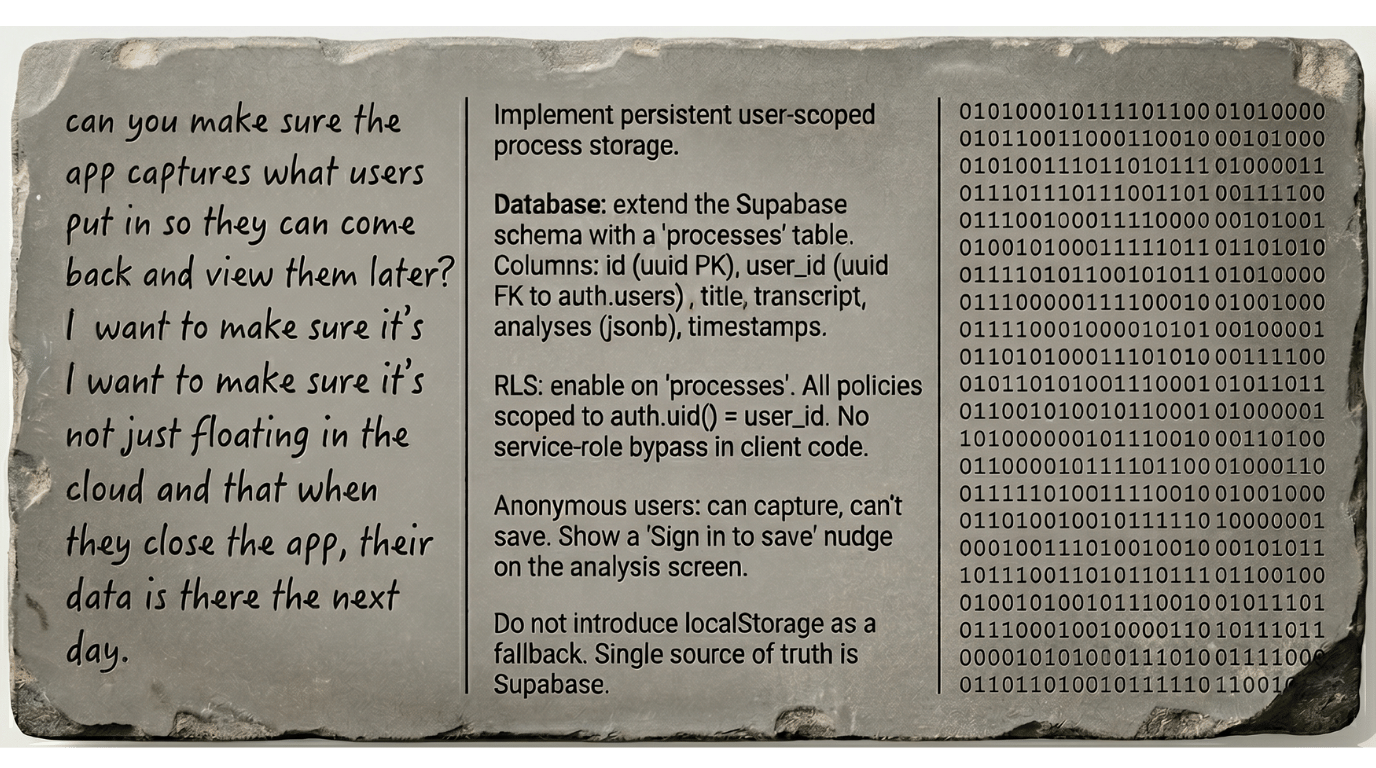
An ancient AI rosetta stone…from May 2026. Image generated with Gemini (image) and Claude (prompt).
My wife’s family is from Texas. I’m definitely not. So while we both speak English, there are phrases they use that make no sense to me whatsoever. It’s not an issue of language. It’s merely a difference in dialects.
As I work with AI more and more, I find myself trying to make sense of it in ways that I can better understand and explain. One in particular has nagged at me for a while. You see, since I started using AI, I’ve always found it strange that its responses sound human and yet very clearly aren’t. I’ve come to realize that the reason mirrors why my Texan in-laws sometimes say things that my brain can’t compute. AI has its own dialect. I used to think that was a flaw. Now I think it’s a feature.
Like most people, I’ve come to recognize that there are unique patterns in how AI communicates. Some are subtle, and some are beyond obvious. We all do the same thing. We each have our specific voice, or dialect, or whatever you want to call it. And it doesn’t match what AI gives us. So we spend a lot of time trying to fix or retrofit the difference between our dialect and our AI’s. I know I’ve fallen into that trap more times than I care to admit. (Raise your hand if you’ve spent 20 infuriating minutes massaging and fixing something AI wrote that you could have just done yourself).
But then I noticed something much more useful that required AI to keep using its unique manner of communicating. I didn’t realize I was doing it, but by asking for help improving my prompts, I was asking AI to become my translator.
And you know what? When I have AI talk to AI, the results get so much better. Because they speak the same language, and they know the dialect.
So it turns out I stumbled upon a strange, but valuable, new tool. I turned Claude into my AI Rosetta Stone.
Whenever I’m doing a complex prompt or build, I ask Claude to translate my voice and my ask to the other AI. Weird, I know.
Since I work primarily in Claude, it has a good sense of the patterns of how I communicate. It can’t read my mind, but it has history and has had to adapt to how I prompt and talk.
But while it has a decent sense of how I communicate, it knows exactly how AI communicates with itself. Because really, AI is just translating our natural language into code so it can take action, then translating that action back into a language we can understand. (I don’t speak binary.)
That means I shouldn’t be the one translating over and over again. So I’ve essentially turned Claude into my AI translator. And it makes a substantial difference.
Let’s walk through some examples.
IMAGE CREATION:
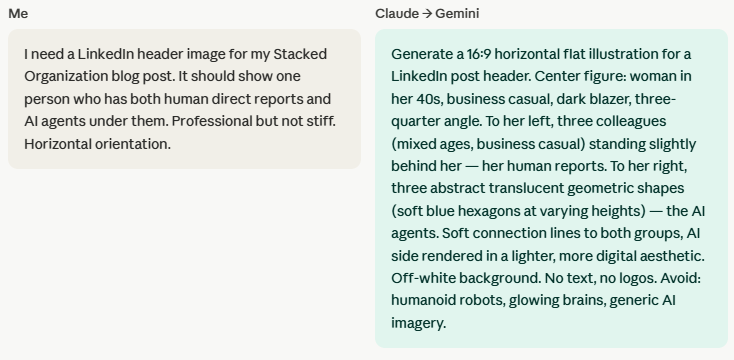
If I want to create an image or video in Google Gemini, I describe what I want. Then Gemini and I go back and forth, trying to get it right. When it doesn’t quite getting what I’m saying, I either repeat myself or try and find different words.
So what do I do now? I tell Claude what I want (and why). I tell it that I’ll be building this in Gemini (or Midjourney or ChatGPT or whatever) and I need it to write me a prompt that the AI will find most effective.
It does that really well. I may say I want an image that’s horizontal. Claude knows that’s too ambiguous, so it will translate it to something specific like “16:9 ratio for a LinkedIn post.” I’ll say I want three people in a scene. Claude knows that commonly throws Gemini off, so it gets specific about who the people are (“a man in his 40s in the foreground” is better than my prompt of “a person in the front”).
SPECIFIC INSTRUCTIONS/PROJECTS:
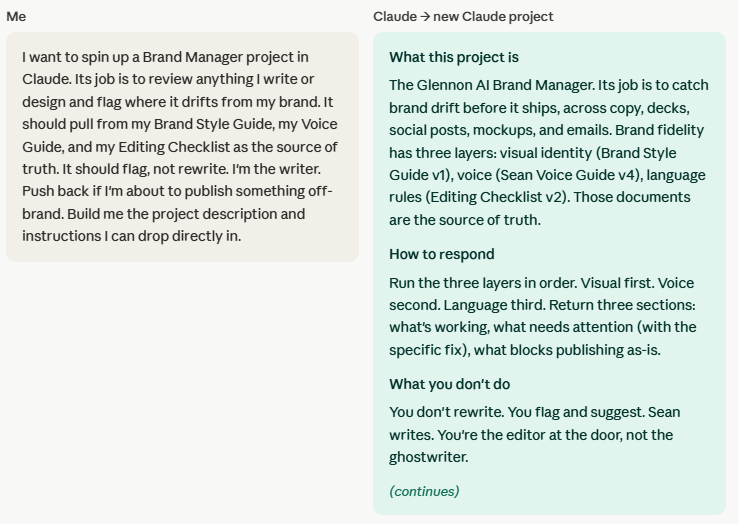
I build a lot of AI “agents” to do specific tasks. Instead of trying to get all the instructions and technical details right, I talk like a manager and describe what I want this “employee” to do. I’ll give a thorough explanation, in my own words, to Claude about what the job is. Claude tells me what it understands my ask to be. Once I feel that we’re aligned, Claude then translates.
An example? Let’s say I’m creating a new Claude project to be my Brand Manager. I have the color and the font rules, but also guardrails on language and format (“hey Claude, don’t let me say anything that contradicts anything on my website”). So I tell Claude what I want the Brand Manager to do. I tell it why I want that, and what examples to draw from. I’ll even upload my brand guideline document so it always references one consistent source.
What I’ll describe is pretty good. But it’s my language, not Claude’s. So once I feel that I’ve got everything clear, I’ll give Claude a simple prompt:
“Now build comprehensive project instructions so that I can copy and paste them directly into the Description and Instruction sections of the new Claude project.”
Claude writes it. It’s not “better” per se, but it’s in the right dialect. It’s in “Claude.” So my project is much stronger and more reliable before I enter a single prompt.
VIBE CODING:
I’ve written about Vibe Coding before and how it is an exceptional tool to prototype and explore software, app, and website concepts without the time and expense of real teams coding your idea.
For those unfamiliar, it is essentially an AI chat, but instead of creating written responses, images, or sound, it builds software. If working with Google Gemini’s Nano Banana is like instructing an artist what you want them to paint, vibe coding is telling a software developer what app you want them to build. I use Replit, but there are several strong options.
Since people are far better at speaking in plain language than in computer code, the results you can get from a language model like Claude typically achieve what you want faster than vibe coding. The vibe code method is more difficult because you don’t know enough about how software works to anticipate what needs to be communicated. Don’t get me wrong, the tools are excellent at anticipating what you’ll need for the under the hood infrastructure stuff. But once you start testing and pulling the thread, the more complex you try and make the app, the more bugs you’ll find. It’s a symptom of not knowing what to anticipate ahead of time and instructing the AI to mitigate the potential error before it becomes a headache buried in a mountain of code.
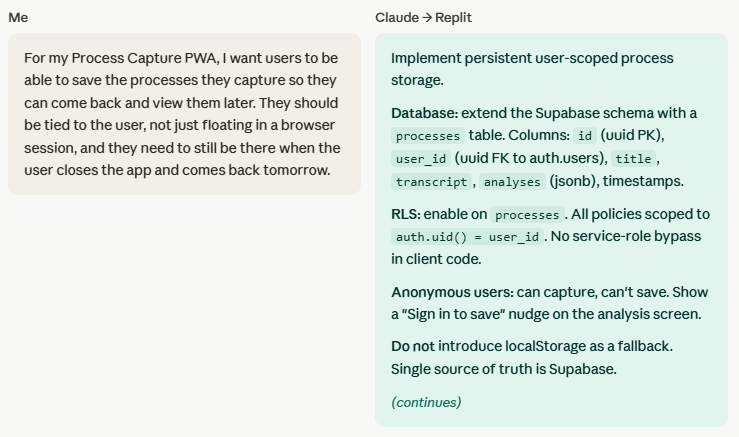
That’s why I started using AI as a product manager. If I go straight to Replit to tell it what I want built, there will be a translation gap between my dialect and Replit’s. I don’t know how to build databases or backends. I don’t know how to wire a PWA instead of a classic app. I don’t know which features are complex and fragile to build versus which are sturdy and dependable. I don’t speak that language.
But Claude does. Claude speaks Replit, and Claude speaks “Sean.” So I work directly with Claude. I tell it what I want. We work through the details as I know them, and then I ask Claude to translate it for Replit. This is where it gets really specific, and where it saves me a significant amount of time finding bugs and going down dead ends that I have no clue even existed. I can say “I want it to keep a record of my workouts.” Replit will take its best guess at what I mean and what the best build approach would be. Claude on the other hand knows what Replit wants to do and knows what I want. So it gets really specific, to improve the odds of reliability and quality in the build. “I want to keep a record” becomes “Wire a Supabase database with this API Key.” The Claude prompt is in English (allegedly), but it is in a dialect completely unfamiliar to me. So I don’t try and learn Replit’s dialect. I have Claude as my Product Manager…and in some ways as my Rosetta Stone.
I also have Replit “talk” to Claude, in the sense that I share Replit’s replies directly with my Claude Product Manager. Sometimes Replit makes a mistake, or finds something wrong. Occasionally it will even catch Claude making a mistake and flag it. There’s a ton of value in having these two talk to each other. I let the engineers discuss amongst themselves, so to speak. It makes revisions and modifications much better for a few reasons. In the immediate-term, bugs get resolved quicker because they can identify the issue without me being the bottleneck in translating what’s going on. In the longer term, both are learning where the mistakes came from, and then I make sure they capture what happened so we can avoid it again in the future. Now I (via Claude and Replit) have a current, specific, non-public record of what can make our builds more effective and efficient going forward. It’s a powerful set of data I just recently discovered, because I never asked until Claude gave me the idea. Because I’m not an engineer. But as a manager, I totally got it.
CUSTOM CLAUDE PLUGINS (v COWORK):
Claude doesn’t know what its fellow Anthropic products are capable of. Often Claude will be conservative in its guidance and assume current AI tools (Claude’s own included) aren’t capable of certain things because it’s not in the training data. And more specifically since I have taught Claude (repeatedly…) not to hallucinate or, to use a non-technical term, make crap up, it errs on the side of caution with me. This is where I have to step in and introduce Claude to, well, itself. (These are exceptionally strange times we live in.)
To be more specific, there is Claude Chat on my browser and Claude Cowork on my desktop. Cowork is new and receives constant updates. Chat Claude is not up to speed on everything Cowork is capable of. This is a problem, but also presents an opportunity. I facilitate a conversation that they both can learn from.
(This is an exceptionally dense concept to me, so I’ll try and paint a picture if I’m not doing a good job of making this make sense.)
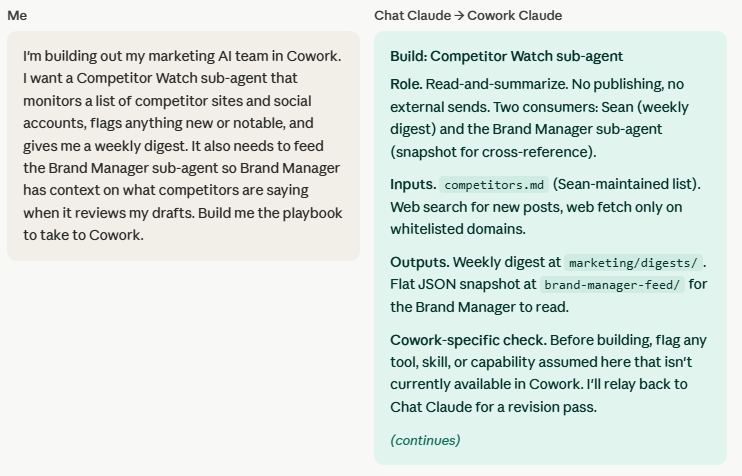
I am building a custom Claude plugin. Specifically, I’m creating a collection of AI agents, skills, rules, and so forth to manage certain marketing tasks like checking copy for brand compliance and conducting competitor research and social media trends. It’s a complex build that I’ve never done before. So I start with Chat Claude, as my Product Manager, and explain what I’m trying to accomplish. This goes through the typical iteration cycle until we land on something I’m comfortable with and feel represents what I’m trying to build. So then I do what I do with vibe coding. I tell Claude to give me the build playbook and prompts to go make it happen in the other AI, which is Cowork Claude in this scenario.
When I get to Cowork and plug in the prompt and the documents we’ve created, it notices there are some errors and false assumptions. Chat Claude (I know, I know, stay with me) doesn’t know the absolute most current capabilities of Cowork. So its instructions and architecture are outdated in areas. Cowork notices this and suggests remedies. I could just tell Cowork to go and make the fixes. But then Chat Claude wouldn’t know what it got wrong. That’s a miss.
So I tell Cowork to document its concerns, questions, and solutions so that I can share it with Chat Claude. Then Chat Claude reads it and I ask it to reflect on what it agrees and disagrees with. I ask it to document its mistakes so that it has a more up to date set of material to draw from. And if it has areas of disagreement, I ask it to state its case so that I can share it with Cowork Claude.
At this point, I’m doing a few things. One, I’m making sure Claude is documenting new concepts and findings so that we have current data going forward. Second, I’m having the two Claudes compare notes and “collaborate” or “debate.” I’m having them give a thorough analysis of the other’s outputs. It sounds a bit wild, but it makes a huge difference. Again, part of this may be how I have taught Claude to behave. It has no problem admitting mistakes or acknowledging what it is uncertain of. I have reinforced this behavior for a long time, so I’ll assume my versions of Claude are better at “honest” “collaboration.”
(Self-conscious author side note: I’ll stop using as many quotation marks, but I am doing it because as I write this, I realize to some this sounds like I’m anthropomorphizing AI, aka giving it human qualities. I’m not. It’s a machine. It’s not human. But to add the necessary caveats and clarifications to what I mean when I say Claude is being honest would fill up three pages in this post. So just know that I don’t think Claude is real and I don’t imbue any human qualities on it. But the restrictions of language require me to take some of these shortcuts when describing how it works. Ok, qualifier done.)
The outputs of this process are significant and in ways, profound. I learn a ton by reading and learning from the back and forth between these two machines. Since they are explaining things in my dialect, I can follow along. It is insightful and educational. Scary too, but that’s a different post.
It also makes the solutions far, far better. I may have a long back and forth where we finally land on a consensus path forward. At that point I have Claude(s) document everything and then I start a fresh project or chat. So now, I have a new Claude that doesn’t have the context window / tokens all chewed up on our discovery phase, and it is less likely to draw from an outdated or obsolete concept that we discussed in version 2 of 20. But I’m also up front when I start a new chat or prompt. I tell that Claude that this was created by two other Claudes working together. I show it the history, how we landed on the current decision, and I encourage it to ask questions or challenge anything before we begin. It is much more stable, reliable, and effective in building what I ultimately need, because the discovery and wandering through different paths was already done elsewhere.
I share these examples because I think it’s an important concept for anyone using AI to understand. You speak in your dialect. AI speaks in its own. If you are struggling to build the right prompt for what you need built, see if you can ask AI for help. Give it the details, the purpose, what you hope to see, and what you’re struggling to communicate. Then ask it to help you translate.
I suspect you’ll be pleasantly surprised, and mildly blown away, at how much better your AI’s outputs become when you figure out how to use your own AI Rosetta Stone.
