Bots and Bottlenecks: Don't Build a Solution Before You Understand the Actual Problem
Over the course of my career, I've always been tasked with solving problems. Whether building a new organization or fixing broken processes, that was my favorite part of the job. The thing to solve for was never the same, and neither were the solutions we built. And over time, I noticed that I kept coming back to the same approach no matter the situation. I kept looking for where things were "stuck." I didn't realize it, but I was searching for bottlenecks.
It's easy to miss bottlenecks when a process is well established and complex. In business, you typically inherit the process. You're trained on how it's done ("just follow the steps and you'll be fine, kid") and that's that. You know where things are frustrating or slow. But fixing it is above your pay grade. So you do what you do best. You figure out a way to get the job done.
I have seen some magnificently complex workarounds to about every process you could imagine. When you hire smart, capable people, they will always figure out how to get the job done. But over time, it compounds. It’s more frustrating. More fragile. You get new tech or a new process and you bolt it onto the old one. No wonder it starts to break more than you want.
AI is the latest version of this classic mistake. Leaders and teams complain that they've been forced to use AI in their jobs (whether implicitly orexplicitly). Go build an agent or GPT. Reduce your staff and just replace them with AI. It's the same thing I saw before AI. People skipping the actual problems they need to solve and slapping on a "solution" that doesn't actually fix much of anything.
A definition of bottleneck
A bottleneck is a point in a process where something gets stuck. In manufacturing, it's physical (too many widgets on the conveyer belt). In an office, it's information. It can be harder to see, but it can be the key to unlocking the whole thing.
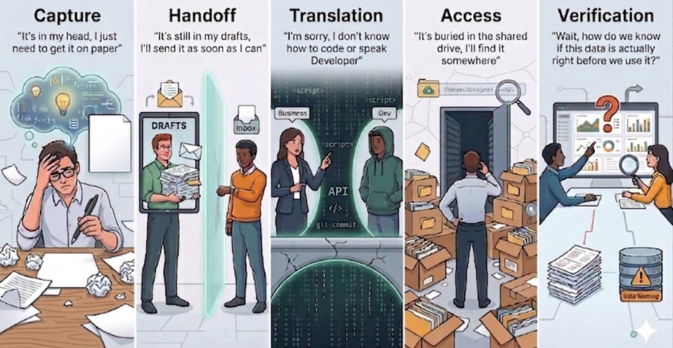
So when I'm with a new client, I don't start with solutions. Instead, I ask about processes that need to be improved and I look for 5 common types of bottlenecks:
Capture ("It's in my head, I just need to get it on paper")
Handoff ("It's still in my drafts, I'll send it as soon as I can")
Translation ("I'm sorry, I don't know how to code or speak Developer")
Access ("It's buried in the shared drive, I'll find it somewhere")
Verification ("Wait, how do we know if this data is actually right before we use it?")
You know these already. I'm not sharing complicated process engineering concepts or management theory. I'm not telling you how AI can solve all your problems. I simply want you to recognize that improving a seemingly broken or sluggish process can happen faster and more effectively than you think, and that you already have most of the skills to make it happen.
For this article, I’ll be focusing on the first three bottleneck types. And I'm going to spend the most time on Capture, because it's a universal issue and a way to show you what a full workflow looks like when you find the real bottleneck and build from there. Handoff and Translation will be shorter, but the same thinking applies.
Capture Bottlenecks
The key questions: The information is in a format we can't use or easily get to. What's stopping it from being in a format that we can actually do something with?
Classic Example: John is retiring. He's done the job for years. His documentation isn't great and the transition folder is sparse, to say the least. He says he'll get to writing it all down, but right now it's just all stuck "up here" (motions to his head). The bottleneck is finding a way to get all that information from his brain into the folders so his successor can do the job right.
Typical Solution: In his last few days, John rushes to find old notes, presentations, and whatever else he has handy. If he's really ambitious, he'll write down some of his tips and processes for how he did the job.
The Solution's Surface-Level Problem: It will be disorganized. It will be difficult to decipher. And his successor won't bother reading it again after the first try.
The Real Problem: There isn't an effective way to capture the information in John's head in a way that makes it useful for his successor.
The Real Solution: Don't make him write it down. Just ask him to talk.
AI-Supported Version:Get him talking and hit record. The transcript is your best data.
The fastest way to get the real information you want is simple. Just ask him to do his favorite thing: talk about the job. The history. The war stories. The processes he built and the clients he managed. If you had a coffee or a beer with John and hit record, you'd get more useful information about what the job really is than forcing him to take a month and document each piece.
So do that. Give John questions or prompts. Sit down with him for that coffee. And hit record. You don't need AI or expensive tech for that. You just need the recorder app on your phone or computer. Have him tell stories or pretend he's talking to his replacement. Get as much as you can.
After that, the data you captured is more valuable than anything in the folders. You have the transcript of the recording. Now you can use AI to format it however you like. Ask questions and do research. Key in on the gaps and the opportunities. This isn't an AI solution. It's finding the real bottleneck and using AI to help get it unstuck.
AI-Scaled Solution:Create a repeatable workflow for any transition. John isn't the first and he won't be the last.
You found a process that worked with John. His transcript has real insights and illuminating stories that never showed up in a transition folder or document. And even better, he enjoyed the experience. He knows that his years of work and knowledge will actually be used by the next generation of folks in his role. In a way, he sees this as a way to pass and protect his legacy. And the data is in a format that can be applied in many ways.
Insights from the transcript were woven into training modules. It helped build a better job description and gave recruiters insights to find and attract better candidates. It uncovered critical gaps in the process that no one saw because John was holding it together behind the scenes.
So, you decide to make this repeatable and scalable. With AI, you create an automated workflow to do this for every retiree (and eventually, any applicable role transition). The workflow happens automatically with key human inputs or checkpoints along the way. Knowledge transfers that would typically take days and weeks (if they even happened at all) are now reduced to minutes, automated, and deliver far more value to the organization as a whole.
Here is an example of that sample workflow, all automated with AI tools and key human inputs:
Manager notifies HR by entering "retiring" in the HR system.
System sends a task to HR and the manager to upload the job description into an online form. They also have the option to upload any other relevant job documents and/or key questions they would like the retiree to answer.
AI (using a prompt template) reviews the job description, documents, and/or questions and builds a tailored questionnaire for the retiree.
The retiree gets the "Retiree Interview" task in their inbox. Retiree clicks the button and is brought to a website (computer, tablet, or phone compatible).
On the website, there are a maximum of 10 questions for the retiree to answer, customized by AI based on the manager/HR inputs. The retiree has the option of writing down their answers or clicking the Record button and simply answering the questions out loud.
The answers are recorded and if there is a transcript, it is saved exactly as the retiree responds.
The answers and transcript are then sent back to the manager and HR. They review the answers, make any necessary modifications, and then mark what it should be applied to. Options include: Successor Transition Document; Potential Training Materials; Succession Planning and Org Design Input; Further Insights For Review.
Each place the content is sent to then has its own AI workflow. For instance, if the manager selected Potential Training Materials, then the materials are routed to the Learning & Development team to use within their content creation workflows.
Handoff Bottlenecks
The key questions: The information is in a usable format, but it's stuck at one or more points between Step A and Step G. How can we get it "unstuck"?
Classic Example: The local gym offers personal training sessions. They have interested customers and available trainers. There needs to be a way to connect clients to the right trainer based on their needs and approach.
Typical Solution: Email the fitness manager when you're interested in a session. The manager will ask the client some questions, and then reach out to the trainer(s) they think would be the best fit.
The Solution's Surface-Level Problem: It's slow for everyone. The manager needs to keep checking the inbox. The client has to wait for a response and then answer questions. The trainers are waiting for who the manager thinks is right. And everyone has to wait as schedules are aligned and the first session actually booked.
The Real Problem: The information handoffs are manual and inefficient, requiring too much action from a single party (the manager).
The Real Solution: Streamline the conversations.
AI-Supported Version: Identify where the process takes the most time and effort. One place is the initial client intake. An email, then a response, then answering questions can be combined into one step. Have the client click a link or QR code, complete an intake form, and it automatically goes to the manager's inbox.
AI-Scaled Solution:Create a customized intake form, a trainer interest-indication process, and a collaborative scheduling tool, all stitched together with an automated workflow.
What once took days (information gathering, requests for trainer interest, and availability alignment) now takes minutes.
The intake form can be built to include an AI chatbot that will customize questions based on the recipient's answers. The logic and rules are built by the fitness manager based on what they know their trainers need.
When client flow is light, trainers jockey for position to take on new clients. If the manager goes to one trainer, the process seems unfair. If it's just a mass email to the team, it's a free-for-all. So automate the outreach to the trainer team with the specific data points from the intake conversation, crafted to what trainers need to know when deciding if a client would be a good fit. It's more thorough and importantly, fair.
Build in a ready-made calendar tool (such as Calendly) that the client and selected trainer can use to schedule sessions. It can be built into the scheduling and manager workflows, while giving the client a better method of getting on schedule.
Translation Bottlenecks
The key questions: Two parties need to communicate and share data, but there's an issue with understanding one another in the level of detail required. How do you bridge that gap?
Classic Example: The client needs a custom software enhancement, so the sales lead tells them it won't be a problem for the software team to build in-house.
Typical Solution: The sales lead gathers the request details from the client. They then go to the software development team and say "build this, I told the client it wouldn't be a problem."
The Solution's Surface-Level Problem: The developers are upset because they don't have the details they need to do a proper build. The sales lead is upset because they feel their instructions were crystal clear and they don't understand why it's so difficult to make a simple update.
The Real Problem: Sales doesn't speak Developer, so they aren't giving them the information they need. Developers don't speak Sales, so they don't know how to translate or ask the right questions.
The Real Solution: Build an AI product manager.
AI-Supported Version: Build an AI agent to be the liaison between the sales and software developer teams. Have your software development team share the key questions they need answered whenever they do these types of builds. Have sales create the list of must-haves for every build to make sure the developers don't go too far off course. Then build an AI agent that interfaces directly with both parties to help gather and translate the information. Product managers are not a new concept. But instead of having someone do the job personally, you can build an agent that is able to manage this (relatively) autonomously, within the framework you've defined.
AI-Scaled Solution: Build 3 AI agents that work together, requiring human oversight at the beginning and end. The sales lead talks to the agent that gathers all the details. That agent then translates the requirements for the AI product manager so they have exactly what they need to create the build guide. The AI product manager then works with a senior (human) engineer and their (AI) team to build.
My Final Point: You Got This.
These examples are structured to show you that AI is a very valuable tool, but using it is not the most important part of the process. The most important part is identifying the bottleneck and understanding what the real, root problem is. If you skip that step and just jump to an AI solution, you're just covering up a foundational problem that will inevitably come back to cause issues down the line. And when that happens, it won't be because AI isn't good enough. It's because you didn't take the time to build a solution to address what the real problem was. That's the piece AI can't fix.
