People Are Looking At Me Funny: Explaining Why I’m Starting An AI-Focused Business
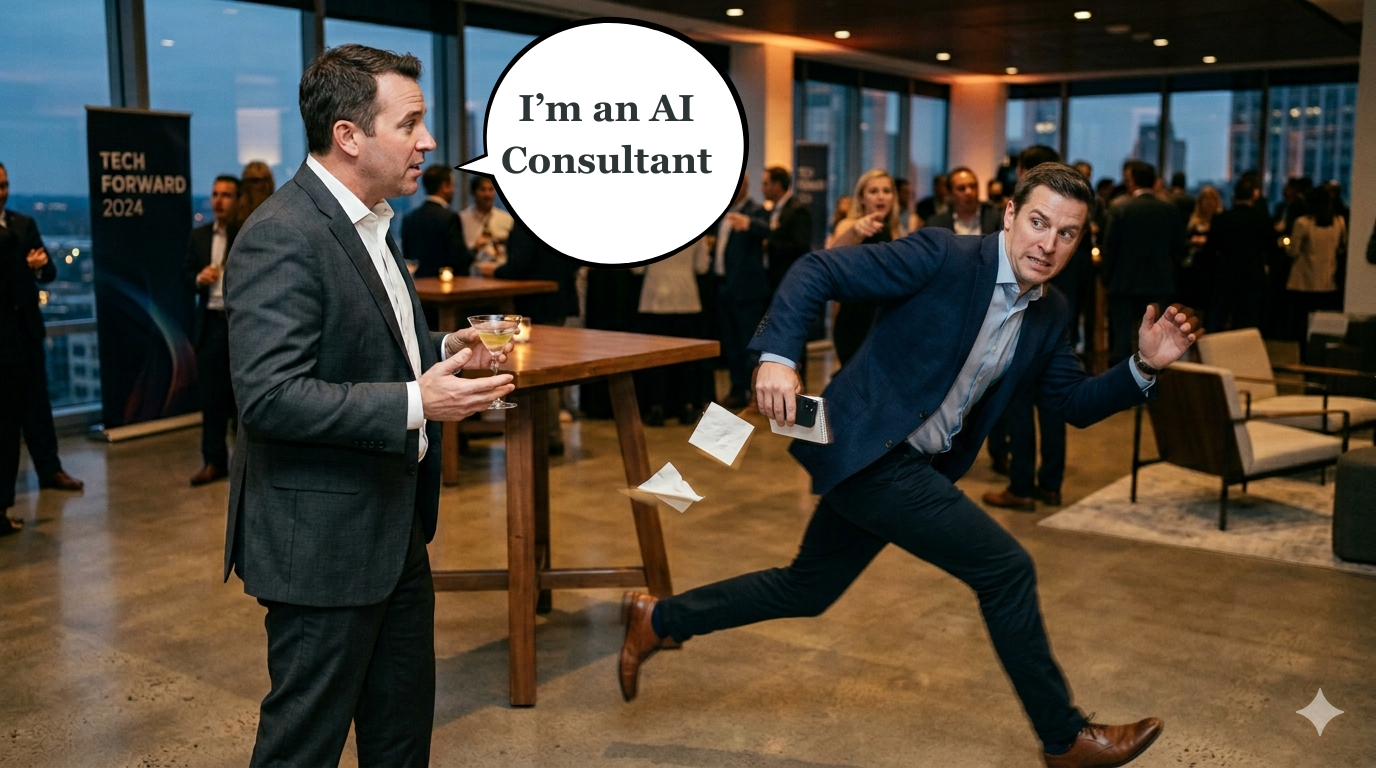
I mean, not really, but sort of, it’s complicated. I just know how to save your business a lot of time and money, and get you generating revenue faster. Oh wait, you already left the room. Fine. (Created by author with Google Gemini).
I’m used to getting a bit of side-eye or a quick change of topic when people ask me what I do for a living. It was always the most obvious when my wife and I would meet someone new. The small talk intros would start, and the “what do you do for work” question would invariably come up, right before or right after asking what activities our kids were in. My wife typically went first, and she’d humbly share that she’s an interior designer. I’d quickly follow up as her unsolicited hype man and add the necessary details she’d never dream to say: “She’s owned her company for 12 years”, “Award-winning across multiple categories in two states”, “and…[ouch]”. The ouch part is when she elbows me in the ribs to stop talking.
This is then followed by a torrent of excited questions. People that want to hear the stories, know her inspiration, and get a view into her life as a designer, business owner, and mother. It’s always fun for me to just sit and listen.
After they have thoroughly dissected the latest industry trends and given deserved credit for the juggling act a working mother has to manage, they turn to me. Sigh.
That’s when the air typically came out of the balloon, so to speak. “What about you Sean? What do you do?” That’s where I tell them I work in HR. “Oh, recruiting?” No, I lead HR for a division at a mega corporation. “Oh.”
And that’s typically the end of that conversation. I get it. HR isn’t the most glamorous or interesting profession. Especially not compared to the cool stuff my wife gets to do on a daily basis. But it was something I enjoyed, so on the rare occasion someone asked a thoughtful follow-up question, I could get a little burst of energy and tell them why my job was an interesting challenge. Usually though, it was a nod and then a quick change of subject. No one wants to talk to Toby.
I share this because when it came to HR, I was used to that reaction. I was good at what I did, I worked with wonderful people, and it was interesting work. So I didn’t need much validation. I was content with the reaction I got. It was predictable and subdued.
But the conversations and reactions have changed lately, because I’ve made a decision that is interesting to some, concerning to others, and baffling to the rest. I’m helping people understand and use AI in their professional lives. I’m consulting on practical applications of AI and helping businesses build tools they can apply tomorrow. And now I don’t get the nice little nod of acknowledgement. It’s a more noticeable reaction because it catches nearly everyone off guard. Who the heck does that? What is this business exactly? Why???
And when I first thought about that last question, “Why???”, I had the same reactions. This was not a predictable path for me. I’ve never really been interested in consulting. AI is a concept I deeply struggle with on both an emotional and intellectual level. Plus, I am doing this in spite of other interests and options I could actively pursue in my career.
So for my sake as much as yours, let me tell you why I still decided to start an AI-focused business anyway.
To frame the context of the reactions to the “I work in AI” statement properly, let’s take a look at the current state of the general public’s view on the topic.
A recent NBC News poll (March 2026) proved what most people already assumed to be true: Most people don’t like AI. AI’s net favorability rating was lower than every single US politician included in the poll. Pick the most loathed politician you can think of. Got them in mind? In terms of public opinion, AI scored worse. That’s a pretty damning stat. It shows a level of distrust that is genuinely unique.
So where do I personally fall on the AI sentiment scale? While I’d say I’m more positive than most, I certainly still have real reservations about it. Since I first tried ChatGPT, I’ve been in the same boat as nearly everyone else. I don’t love AI. It’s a technology we haven’t seen before, moving at a pace that is unprecedented, in an environment where the knowledge and guardrails can’t possibly keep up, at least not in real-time. Applied in the wrong way, it can be disruptive at best, and unfathomably dangerous at worst. We don’t have a clue as to what the outcomes of all of this are really going to be. I worry about my kids’ mental health and cognitive development. I worry about economic and employment impacts. I worry about our collective ability to be honest with ourselves and each other about the good and bad of this technology. If social media is any indicator, we’ll have a lot of room for improvement when it comes to harnessing these tools for good and protecting against the harm it can cause.
I’m also generally not a technology enthusiast. I’ve not really an early adopter and I don’t pride myself on being any kind of tech expert. I am an elder millennial (aka the “Oregon Trail Generation”), so at least I’m a digital native. I know how to do it. I’m comfortable and not generally intimidated by it. But I’m certainly not the biggest tech fan you’ve met.
So that gives you a sense of my baseline tech and AI feelings. It will be important when I share why I still decided to jump into the fray.
I’ve also never wanted to go into consulting. I like building things and being part of a team. I like having a vested interest in the success of a project and seeing it through. Consulting felt too much like a gig, somewhere you drop in, get the ball rolling, and jump out, without ever getting to finish what you started. It felt like a lonely profession, full of transactional and transient relationships, no matter how friendly or positive things seemed.
And to be honest, I’ve been in a field where I’ve always had to work with consultants. Some are brilliant. Some less so. There’s a wide range because it’s a very crowded field. I didn’t like the stereotypes filled with cliches and decks and constant over-promise. That wasn’t all of them, but I did see it enough that I knew I didn’t want to do that. I didn’t want to build decks and theory. I definitely didn’t want to do business development. I like authentic, organic relationships that are built and earned over time. And I didn’t feel like consulting would allow me to do the things I wanted, in the way I wanted.
So I clearly wasn’t drawn to AI or consulting. And yet I started Glennon AI to do both. Again, why???
Well, last year I left my 20 year career in Corporate America to go do something on my own. What? I wasn’t sure. That needed to be figured out. As I thought about the question, I realized I was being forced to answer a common hypothetical I’d been asked many times before:
If you won the lottery but still had to work, what would I do?
The framing of that question is a way of uncovering your real professional passions and interests. And what I realized, now that I had to be honest with myself and actually make a decision, was that I wanted to use my experience and expertise in business to help others achieve their own professional success.
There are millions of people who have all the talent but don’t have the resources, access, or experience to be nearly as successful as they could be. I love helping people figure things out. People with untapped potential. People that place a bet on themselves. Leaders doing their absolute best for their entire team, big or small, unified in their passions and purpose. I felt I could genuinely help them.
One of the reasons I was successful in the corporate world was because I have a skill at taking things that are complex or abstract and communicating them in a way that makes sense to others. To take a challenge and help create solutions that worked in unexpected ways.
And from a people standpoint, I love building up people’s confidence. I love helping unearth skills and talents they didn’t realize they had, or showing them how to apply the ones they already knew about. I love to see others succeed and have gratitude when I see the part I played in finding their success.
That’s why I truly enjoyed being a leader. I had so much fun developing talented people who I knew would end up being my boss in the future. They had the intelligence, determination, and creativity to be great. They just needed someone to help them build confidence, experience, and perspective. That was my favorite part.
I decided that would be my approach to consulting. I would focus on being collaborative, partnering to develop both the processes and people. I’d teach people to fish. I’d help them achieve their goals by sharing my expertise and building things alongside them.
Fine. Consulting actually made sense because I’d be the one deciding how it’s done. But the AI piece. That took longer to figure out.
Like I said, I have significant, deserved reservations about AI. But I also believe it is a massive opportunity, especially for those who can unlock the profound resources it provides. In order to really understand its full potential, I knew I needed to experiment and explore it for myself, and that I needed to synthesize my thoughts. So my first step was a big one for me. I started to write.
To be honest, I mostly wanted to just do the intimidating thing of writing for myself. I’d spent 20 years applying my literary skills to PowerPoints and emails for others. I wanted to rediscover my creative voice. I wanted to put my ideas on paper, hit publish, and hold myself accountable. That’s a scary thing and I knew it would be good for me on a number of levels.
I also knew that as I was learning about AI, most people didn’t have the time or the interest to go as deep as I was now able to go (a mid-career “sabbatical” does afford time I didn’t previously have). And the more I experimented with it and applied it to my own entrepreneurial ventures, the more I realized I had a perspective that I didn’t typically read about. I don’t come at it from a “this is amazing and here’s the latest and greatest.” I don’t come at it from a terrified doomsday place either. That seemed to be the vast majority of content I saw out there. Instead I come from a practical point of view, focused on real world applications instead of theory and the latest tech craze.
That ended up building my AI optimism, because it was based on personal experience, instead of the opinions of a podcast or an AI influencer (yes, those exist). I’d left a very successful career and started a business from scratch. I had no help and no real resources. It was overwhelming. But I had a unique tool at my disposal that entrepreneurs before me didn’t have. So I (with both reluctance and curiosity) turned to AI. And what I found surprised me. It wasn’t magic. But it was genuinely useful, in ways I did and did not expect.
Since then I’ve built apps with zero coding experience. Automated research workflows. Taught entrepreneurs to build their own prototypes in an afternoon. Lectured to high school classrooms. And I’ve been writing about it, including the stuff that didn’t work.
So that gave me confidence in myself, and credibility with others. I had done the work. I hadn’t just messed around with a couple tools or read articles. I had practical examples and outputs I could share. It was lining up with the consulting thing. I had a unique set of skills and knowledge that I wanted to use to help others. And I had earned the right to say I had expertise. So it was starting to line up in my mind.
But there was another problem. There’s an AI bubble coming. What happens when it bursts?
If I’m being strategic about my career choices, running towards an economic bubble isn’t usually the greatest idea. And make no mistake, I definitely believe there is a real and impending AI bubble forming (and really, it’s already formed). I just don’t see how there isn’t some sort of market correction. Just follow the numbers. The investment in AI has been staggering. Tech behemoths have essentially invested the annual GDP of Ireland and Belgium (COMBINED) over the past decade. Let’s say around $1.6 trillion dollars. Want a different way to visualize that amount of money? Here’s a helpful guide to conceptualize the sheer magnitude of AI investments.
How much is $1 trillion dolalrs? Well, imagine counting to 1 million seconds. That would take you 11.5 days. 1 billion seconds would take 31.7 years. 1 trillion seconds? Oh, just 31,700 YEARS.
It’s a lot. The profit generation necessary to simply recoup those investments, let alone meet the astronomical growth projections baked into the assumptions, are nearly incomprehensible. I just don’t see things moving quickly enough to deliver the returns they expect. Not yet. Maybe not ever at that scale. So something will break.
The AI bubble will burst in some way. But that doesn’t mean AI disappears, nor does it mean that teaching others how to use it is a foolish venture. It simply means that the economics have to realign and in the meantime the opportunity for the people who actually know how to use these tools is enormous.
So I’d wrapped my head around AI and consulting. I thought I could do something with it. But I was nervous. I didn’t have 20 years of experience. It would be safer if I did HR consulting or went back to an established company. But AI? Yeah, I had been learning a lot and had some interesting use cases. But having people pay me to integrate AI into their business? How would I possibly know how to do that?
That’s when I realized that the conversations I was having with business leaders about AI had absolutely nothing to do with AI. The discussions kept starting the same way they always did throughout my career. Before anything else, it always starts with understanding their business. How do you make money? Who are the customers? What is your team and talent like? What’s getting in your way? What do you wish you could fix if you just had the time and talent to do so?
That’s basic consulting and business strategy design. I can do that, because I’ve done it in-house at companies for 20 years. I had those skills. But now, on top of that, I had an extra toolkit. I had real, practical, hands-on AI knowledge. So when I sit with businesses and start with “what are your business goals and what’s in your way,” I have something new. We used to be limited in what we could solve because we always had the constraints of the talent and budget we had to work with. Now I have a set of tools and resources that changes the math.
If you had the budget to hire 5 people today, what would they do? How would you teach them? What are the critical inputs and necessary outputs? Most leaders already know the answer to those questions. They know what they would do if they had a billion dollar budget. But they don’t, so they’ve had to live with those constraints and trade-offs. AI is the resource that changes the math.
Building real, immediately impactful tools with AI doesn’t require exhaustive expertise in the technology. It just requires a deep knowledge of the business and help identifying where AI can significantly move the needle when applied the right way.
I knew this, but I was still questioning whether I deserved to call myself any sort of AI expert, whether I had earned the right to have people sign up for me to help them. That’s when someone told me something I needed to hear. He said that this was different because all of this stuff is so new. So cutting edge. I need to stop waiting for permission. I need to stop trying to learn as much as possible to pass the test at the highest level. The book is not complete. It’s barely been written. Most people are going to wait. If I believe I know what I’m talking about, if I believe I can add value, then bet on myself. He said that there’s real value in the fact that I’m a couple chapters ahead in the book. That gap can make or break businesses. That gap is a real opportunity, not just for me, but for my clients. I have an advantage of speed and decisiveness in a time where things are unknown and untested and uncertain.
Some people know more about specific tools, processes, or the technical elements. Some people know more about work design and leadership and process engineering. But my specific set of skills, my unique experiences, my particular Venn diagram… with AI on top of it… that genuinely has value.
I don’t care about the hype. I don’t care about being right or wrong about what AI becomes. I just know that right now, and for the foreseeable future, businesses that know how to use these resources and tools in the right way, in the right sequence, with the right framework, can be far more successful than their competitors.
I get excited in those introductory conversations. We talk about the business and they get excited. I talk about AI and you can see it. Their eyes open. They see possibilities. Jaws at times can drop. And it’s not because I’m selling some vision. It’s because I’m looking at how we can actually put this into practice in a way that will help.
I don’t work miracles and won’t solve every problem. But I know I can help in a way that is both unique and impactful. I’m eager to share. I’m eager to learn. I’m eager to build with you. I’m not saying I have all the answers. But with my experience, I can help uncover and unlock real opportunities. And those individuals that are true experts in their domain, if I can work with them and together we can build something great that wouldn’t be possible without AI? That’s a shot worth taking. That’s real value. And it’s something that excites me, motivates me and gives me a sense of purpose that I’ve been looking for.
So I’m ok getting the funny looks. Because I know once we have the conversation, the look will change. I can’t wait.
