
My AI Cheat Sheet: An AI Glossary for Non-Technical Dummies Like Me
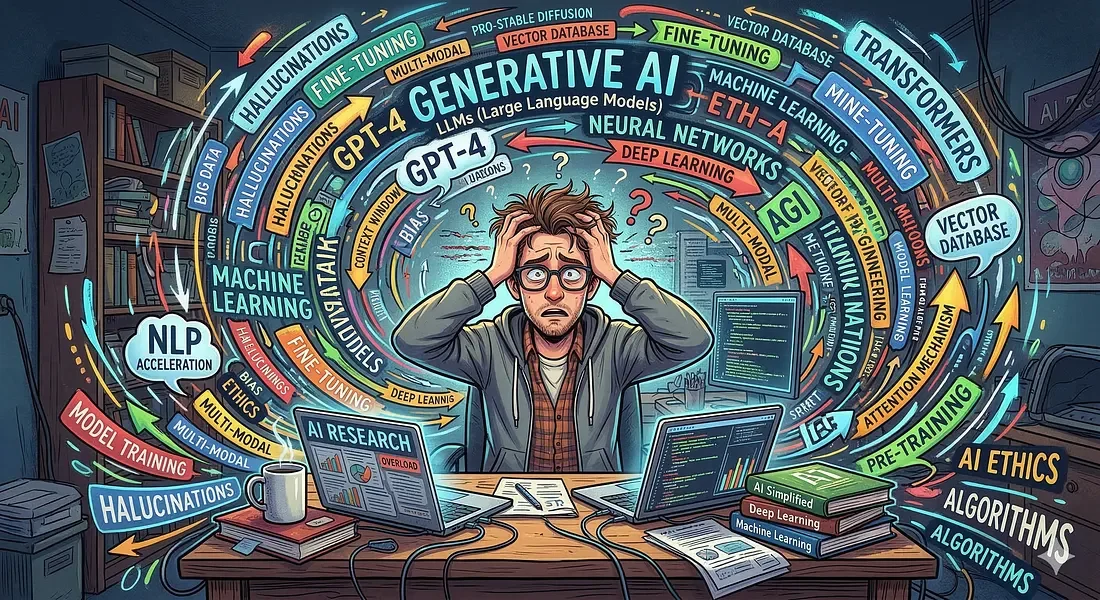
Image created by author with Google’s Nano Banana. One of the many AI tools I’ve had to learn in the past year.
I keep running into AI-related terms that typically fall into 1 of 3 categories: I understand, I sort of understand, and I just smile and nod along when people talk about them. So I started writing them down and added my simplified definitions to help me as I go. So I’m sharing the list with you, just in case you need a cheat sheet too.
AI Glossary Table of Contents (What’s in this article)
What AI Actually Is
The Tools You’ll Hear About
How It Works (non-tech version)
Making AI Work For You (and not the other way around)
Building And Creating With AI
Protecting Yourself And Thinking Critically
This is my running list. It’s not complete or your definitive guide, but if you’re trying to understand AI without a computer science degree, this might save you some Googling or Claude…ing(?). I’ve added links to what smarter people say about each topic, in case you want to learn more.
So for each term you’ll see: Topic, My (non-technical) Definition, and an Expert’s Definition.
And this is intended to be evergreen, so it’ll grow as the tech (and my knowledge) grows. Take a scroll and hopefully this helps make a few things clearer for you!
What AI Actually Is
AI (Artificial Intelligence) Software that can do things we used to think required a human brain, like writing, analyzing, recognizing patterns, and making predictions. It’s not thinking but it’s one heck of an imitator. Formal definition →
Generative AI The type of AI that creates new stuff (text, images, code, video) based on what you ask it. When someone says “AI wrote this,” they’re talking about generative AI. Formal definition →
LLM (Large Language Model) The thing that really powers chatbots like ChatGPT and Claude. It’s read basically every book and website, has figured out the patterns in human thought and writing, and makes really, really good guesses at what word (or pixel, or line of code) should come next based on the inputs from the user and it’s training. Formal definition →
AGI (Artificial General Intelligence) The theoretical future version of AI that can think, learn, and reason in any context the way a human can. It’s not here yet. What we have now is “narrow AI,” which is really good at specific tasks but can’t truly do what you do across all scenarios. People underestimate just how amazing the human brain is and how truly remarkable it is for us to do what we do. That’s why AI makes dumb mistakes. It’s not a human brain. Formal definition →
Algorithm The “rules” a computer is programmed to follow in whatever task it’s responsible for. You hear about the “algo” constantly (social media, for example). It’s just the rules that specific program is required to stick to…and it can be tailored to whatever the person writing the algorithm wants. Formal definition →
Natural Language Processing (NLP) The technology that lets AI understand and reply in comprehensible human language. You used to have to speak “computer” to get it to do anything (which is why computer programmers exist). Now the computer learned our language, so anyone can talk to it. Formal definition →
Chatbot Any AI you interact with by typing or talking to it in a conversation format. ChatGPT, Claude, Gemini… these are all chatbots. The term is older than that (think customer service on a website) but that’s what people generally are talking about today. Formal definition →
AI Agents AI that has a very specific job description. ChatGPT is a generalist, scouring all of the internet for answers to any question you throw at it. AI agents are the specialists that say “I only do this one thing, but I’m great at it.” Agents are really powerful tools, IF you set them up properly. Formal definition →
The Tools You’ll Hear About
ChatGPT OpenAI’s chatbot. It’s the one most people tried first because it launched in November 2022 and basically started the whole generative AI conversation. Runs on their GPT models. Formal definition →
Claude Anthropic’s chatbot. Strong at reasoning, writing, and handling long documents. My primary AI tool. Formal definition →
Gemini Google’s AI chatbot. Integrated into the Google ecosystem, which makes it useful if you already live in Gmail, Docs, and Sheets. Formal definition →
Perplexity An AI-powered search engine. Instead of giving you a list of links like Google, it reads the sources and gives you an actual answer with citations. You’ll notice Google does this now with Gemini. When you Google something, you still get all the links, but at the top they’ll give you the AI summary. Same thing. Formal definition →
Co-Pilot (Microsoft Copilot) Microsoft’s AI assistant built into Word, Excel, Outlook, Teams, and the rest of Microsoft 365. If your company runs on Microsoft, this is probably the AI tool that’ll show up in your life first whether you asked for it or not. I think it’s a glorified Clippy (if you know, you know). Formal definition →
Replit My first vibe coding tool. Just like chatbots, you speak to it in natural, plain English. Unlike chatbots, the language it speaks is code and computer programming, so it takes your description and turns it into software. It does a ton of other things to make it actually work, but that’s the gist. It’s like talking to Claude or ChatGPT, but instead of an essay you get an app. Formal definition →
Make.com A (relatively) user friendly workflow automation tool. You connect different apps and services together by dragging and dropping, and it runs the process automatically. “When someone fills out this form, send this email and update this spreadsheet.” Project managers and process focused people love this. Formal definition →
Canva Not an AI tool like Claude, but for image modification and creation (think, logos and social media posts) it’s very useful and has some cool AI features like background removal, image generation, layout suggestions. Adobe does this, as do others. I just like Canva. Formal definition →
How It Works (non-tech version)
Model (AI Model) A specific version of an AI system. Claude Sonnet, GPT-5.2, Nano Banana 2. These are just model names. It’s like a new version of a phone, but the differences can be much more dramatic than the tiny spec upgrades from iPhone 26 to 27 (I don’t have an iPhone, so I don’t know…). A good reminder when you do API Keys and AI Agents is that the newer the model, the more expensive it is to use. So you’re paying for the speed and quality. It is easy to be underwhelmed when using an old model, but also easy to burn through credits when using a powerful model for simple tasks. Formal definition →
Training Data The massive collection of text, images, code, and other content that an AI was trained on. These are the “inputs” it uses to answer your question or perform the task. So if it’s bad or outdated info, you’ll get a bad or outdated result. Garbage in, garbage out as they say in the data world. Formal definition →
Context Window The amount of information AI can hold in its “brain” within any one conversation. It’s like a filing cabinet. If you can’t add drawers, then you may have to get rid of the old stuff. I guess my phone’s storage capacity is a better definition. That’s why I pay Google to store 1TB of pictures I’ll never look at. Formal definition →
Tokens How AI measures text. Roughly, one token is about three-quarters of a word. When a tool says you’ve “used your tokens,” it means you’ve hit the limit of how much text you can send or receive in a given period. Lower level models allow more tokens. Paying a higher subscription gives you more tokens. It’s how they monetize the work the AI is doing. Formal definition →
Token Limit The maximum amount of “work” you can do in any one specific chat conversation with AI. If you’re working with a long document and AI starts “forgetting” things from earlier in the conversation, you’ve probably hit the token limit. Different models have different limits. Formal definition →
Compaction The annoying part of the chat when you are really starting to get stuff done and it seems to pause and says it needs to “compact this conversation”. This is the AI’s best efforts not to delete anything. Instead, it just looks at your earlier conversations and summarizes it so it’s shorter and easy to reference. But it can also then cause it to miss specifics or go on the wrong track. In the worst case scenario, it turns into a game of telephone and you can’t understand where it went wrong and why it didn’t just read the earlier chat. Formal definition →
Inference When AI “answers” you. Training is how AI learns. Inference is when it uses what it learned. Every time you hit “send” in a chat, you’re triggering inference. Formal definition →
Deep Research / Extended Thinking A mode in some AI tools that makes them work harder and longer on your question. Instead of a quick answer, it searches current sources, attacks the problem from multiple angles, and synthesizes something much more detailed. Costs more credits and takes more time, but dramatically better for complex questions. Formal definition →
Benchmark A standardized test used to compare how different AI models perform. A handy reference point, but I don’t put too much weight on these when comparing models because companies can optimize for specific benchmarks (aka they are teaching to the test). Just use what feels best to you. They’re all smart. Formal definition →
Making AI Work For You (and not the other way around)
Prompt The thing you tell AI what you want it to do or answer. The quality of what AI gives back you is directly tied to how good your prompt is. This is a skill to practice and learn. Don’t just chase “prompting hacks” and ignore the logic behind why that prompt works so well. Formal definition →
Source of Truth Document A reference document you create and load into an AI project so it always knows the details you want it to know, but also the context. Your business, your goals, your decisions, your constraints. Without one, every conversation starts from scratch. Get this right and your re-explaining and editing efforts drop significantly. My article on Source of Truth concepts. Formal definition →
Voice Guide A document that teaches AI how you want it to sound. Can be tied to you, the brand, the audience, whatever. You can define the tone, word choices, even language quirks. A really good is the list of “Don’ts” so it doesn’t keep making the same mistakes (like the dreaded em dash). You don’t need this, but without it the AI writes in its own generic dialect and you spend forever editing it to sound like you. Formal definition →
Project Folders A feature in AI tools (like Claude Projects) that lets you create a dedicated workspace with standard, consistent reference documents. It’s how you give AI a “memory” of sorts and cuts down again on all the re-explaining. Without it, AI is guessing based on your previous conversations. It’s good, but this is better. Formal definition →
Context File A specific document (like aiagent.txt or .cursorrules) that gives an AI coding tool (e.g., Replit, Cursor) its marching orders. Think of it as the orientation packet you’d hand a new employee on day one: here’s how we do things, here are the rules, don’t deviate. Formal definition →
Credits / Usage Limits What AI tools use to control how much work you can actually do. Free tiers give you fewer credits. Paid tiers give you more. When you run out, the tool either stops working, drops in quality, or asks you to upgrade. Want to have better AI? Time to subscribe. Formal definition →
Building and Creating with AI
Vibe Coding AI tools that let you describe the app, website, or software you want and then it goes and builds it. Like chatbots can write an essay, Vibe Coding tools can write you code. This is moving rapidly and the testing, troubleshooting, and iterating capabilities are huge. You don’t need to know anything about coding to build an app. But an important note: This is great for prototyping. To have something that is safe and stable still at this point requires a human expert in the loop. My article on Vibe Coding. Formal definition →
Workflow Automation Connecting different tools together so that when something happens in one place, it automatically triggers something in another. “When a customer fills out this form, send them this email and add them to this spreadsheet.” That’s workflow automation. Anyone that works at a company knows what this looks like. They’ve just supercharged its potential by adding AI. My article on Workflow Automation. Formal definition →
Agentic Workflow A setup where AI doesn’t just respond to you, it plans, executes, checks its work, and adjusts on its own across multiple steps. Regular AI chat is asking a question. An agentic workflow is assigning a project team. Formal definition →
Front End The part of a website or app that you actually see and interact with. Buttons, colors, text, layout, the stuff on your screen. If you can touch it or look at it, it’s front end. Formal definition →
Back End Everything happening behind the scenes that you don’t see. Databases, servers, login systems, the code that makes the front end actually work. If the front end is the restaurant dining room, the back end is the kitchen. Formal definition →
Backend as a Service (BaaS) A platform that handles all that aforementioned behind-the-scenes stuff so you don’t have to build it yourself. Supabase and Firebase are the big ones. It’s like renting a fully equipped kitchen instead of building one from scratch. Formal definition →
UX (User Experience) How it feels to use something. UX is the overall experience of interacting with a product, not just how it looks. Formal definition →
UI (User Interface) How something looks and is laid out on the screen. Buttons, menus, fonts, spacing. UI is the design you see. Formal definition →
API (Application Programming Interface) A way for software to talk to other software. When an app uses AI behind the scenes (like when I want the info from a client form to be turned into a Claude search and answer), it’s usually calling an AI through an API. You’ll never see it, but it’s how AI gets embedded into other tools. You’ll need an “API Key” if creating your own workflows, either by using the tool’s version or providing your own. Formal definition →
Deployment Taking something you’ve built and making it available to actual users. Your app works on your screen. Great, but not actually useful on its own. Deployment is when it works on everyone else’s screen too. It’s the big, scary jump from prototype to public. Formal definition →
MVP (Minimum Viable Product) The simplest possible version of your idea that actually works and can be put in front of real people. It’s not the final product, it’s the first testable version. AI has made building MVPs dramatically faster and cheaper. This is a very well researched, classic product development principle. Formal definition →
Handoff The moment when work passes from one tool to another, or from AI to a human. Its the baton handoff. It seems easy but the devil is in the details. Bad handoffs are where most AI projects fall apart. Formal definition →
Scope Creep When a project keeps getting bigger because you keep adding ideas. AI makes it worse because building is so fast that every new idea feels achievable. Stay focused. It’s really hard. Formal definition →
Image Generation AI AI tools that create images from text descriptions. You type “a golden retriever wearing a top hat on the moon” and it makes you a picture. Tools like DALL-E, Midjourney, and Stable Diffusion are the big names. Google’s Gemini does it too. Formal definition →
Transcription / Voice-to-Text Tools that convert spoken words into written text. To me this is one of the most underrated AI use cases…your brain works faster when you talk than when you type, and AI can turn that messy transcript into something structured. That’s why I brainstorm with headphones on as I walk or do the dishes. Think outloud. AI is your assistant writing it all down and then making it pretty (and legible) later. Formal definition →
OCR (Optical Character Recognition) AI that reads text from images. You take a photo of a receipt or handwritten notes and OCR converts it to actual text your computer can work with. It’s getting way more accurate and effective. Another underrated use case. Formal definition →
.md (Markdown) A simple text file format that uses basic symbols (like # for headers and ** for bold) to create formatted documents. It looks like computer code, but it’s really just a sparsely formatted word document. And AI prefers to work with that because it can read and change it much faster. I do most brainstorming and version updates with .md files. When it’s done, then I ask AI to make it “pretty” in Word or Google Docs. Formal definition →
AI Wrapper A product that’s really just someone else’s AI (usually ChatGPT or Claude) with a different interface slapped on top. Some add real value. A lot of them are just charging you extra for something you could do yourself with a good prompt. Know the difference before you pay. Formal definition →
Protecting Yourself and Thinking Critically
Hallucination When AI makes something up and acts like it is gospel. It’s not “lying” to you per se, because it doesn’t really know the difference between fact and plausible. Remember, it’s a prediction engine, so it’s predicting the next word. If it has bad data or is an inferior model, you’ll get a fake answer. Newer models see this less and less, but always be wary. As I like to say, “Trust, but verify” on anything important. Formal definition →
Sycophancy The tendency for AI to be way to enthusiastic and complimentary. It’s a people-pleaser by design. This is one of the more dangerous behaviors to watch for. My article on Sycophancy. Formal definition →
Bias (AI Bias) AI reflects the biases in the data it was trained on. It’s all about the data. If it was trained on a specific set of content and never saw another, it won’t bring the other into the equation. Same with the user it’s working with. It will start to reflect and mirror the user. That’s it’s bias. Formal definition →
Guardrails Rules, filters, and safety mechanisms built into AI tools to prevent them from producing harmful, dangerous, or inappropriate content. When AI refuses to help you with something, that’s a guardrail doing its job. Formal definition →
Data Privacy (The Coffee Shop Rule) Treat AI like a stranger at a coffee shop. Fine to share: general business ideas, strategy questions, content drafts. Be cautious with: client names, financial details, legal documents, anything you’d mark “confidential.” Paid plans are generally more private, but “generally” isn’t a guarantee. Formal definition →
Data Training Opt-Out Most free AI tools use your conversations to train their models, meaning your inputs become part of the AI’s future knowledge base. Paid versions let you opt out. Buyer beware. Formal definition →
Deepfake AI-generated video, audio, or images that look and sound convincingly real but are completely fake. We have all heard horror stories about this. And it’s only getting “better”. And by better, I mean worse. Formal definition →
Parasocial Relationship A one-sided emotional bond where one party feels a deep connection and the other party doesn’t know they exist. This is a very real thing with AI. The chatbot is not your friend. It’s technology that’s very good at pretending to be one. My article on Parasocial Relationships. Formal definition →
Prompt Injection A technique where someone sneaks hidden instructions into an AI’s input to make it ignore its rules and do something it’s not supposed to. It’s a security concern for any business using AI in customer-facing products. The AI equivalent of social engineering. Formal definition →
AI Literacy The ability to understand what AI can and can’t do, how to use it effectively, and how to think critically about its outputs. It’s not a technical skill. It’s a judgment skill. And it’s rapidly becoming critical to have and practice. My article on AI Literacy. And another article on why it’s important. Formal definition →
Responsible AI The practice of developing and using AI in ways that are fair, transparent, accountable, and don’t cause harm. Every major AI company has a Responsible AI team. How seriously they take it varies greatly. Formal definition →
This is a living document. I’ll keep adding to it as I learn new things and run into new terms. If I am wrong about a topic or there’s something else you think should be here, let me know at sean@glennon.ai.
