How Should You Learn AI in 2026? With Curiosity and Patience
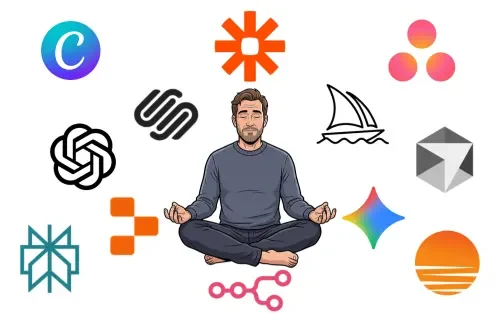
Me trying to learn AI. (From left to right, top to bottom: Canva, Zapier, Asana, ChatGPT, Squarespace, Midjourney, Cursor, Perplexity, Replit, Gemini, base44, n8n.)
My algorithms tell me a lot of stories and predictions about AI. It is the gateway to a utopian future. It will boil the oceans and eventually bring on Skynet. It’s only for techies. It’s just hype. But one thing I’ve noticed lately on mine is that not only do I have to learn everything I can about AI as soon as I can, but if I follow the 28 (or is it 21?) day plan I can become an AI genius and assure myself a path to millions.
I don’t buy it.
It’s not that I don’t believe that the various tools included in these courses are useless. On the contrary, some of them are exceptionally powerful and valuable. And it’s not that these tools aren’t worth learning. They are. It’s that it’s being sold to me with standard sales gimmicks. “This offer expires soon”. “Don’t miss out on the next big thing”. “If you simply follow our guide, you will gain wisdom and skills far above any of your peers”. There’s this feeling of urgency, of scarcity, of the pot of gold at the end of the AI rainbow. It just strikes me as hollow and familiar.
I don’t believe “microdosing” 5 minutes of AI tutorials at a time makes much of a difference. It’s just another thing to scroll through. I don’t think applying the “grind culture” mindset to AI education is a healthy shift. I don’t want to be pressured into trying to learn everything and always be cutting edge. I just don’t.
When it comes to AI, what I want to be is curious. And to be truly curious, I need to be patient.
I don’t think that anyone really has a true, deep expertise in AI at this moment in time. Some are experts in aspects of it. Creating it. Leveraging it for your specific niche. But it is developing so rapidly that AI itself can’t keep up, let alone humans. Seriously, when I ask AI about a new product (such as talking to Claude about Google Antigravity) it knows less than I do. Yes Claude, I read the same Wikipedia article, thanks.
This isn’t a bad thing. In fact, I think it’s a great opportunity. An opportunity for you to tap into your curious mind and explore at your pace, in your way. Stop trying to copy someone’s method comprised of various AI Hacks and Pro Tips™. Don’t microdose learnings on 10 things that you won’t remember or keep straight. Don’t study the latest benchmarking results between Chatbot A, B, and Z.
No. Instead, be curious and start to use it. Pick something you’re interested in learning. Maybe it’s something to help make your day or job easier. Maybe it’s a creative passion that you haven’t had the time or tools to dive back into. You’re not going to learn it by watching a TED talk. You’re going to learn this by experimenting with it. Playing with it. Being curious. Because you’ll be learning the foundation of the technology, not just the latest specs. It’s going to change and improve by the time you figure it out, so spend your time on just understanding how it functions and flows, not the perfect prompt to hijack the chatbot.
The “I found the perfect prompt” folks give me a bit of trouble. On one hand, I love the creativity. I really respect trying to find new ways to prompt (speak with) AI to improve outcomes. I think I’m naturally doing that in my experiment of partnering with Claude. But if you spend too much time on just memorizing prompts, the models will change faster than you can keep up with what works. It’s better to find your voice, articulate your ideas, and then be curious about what the response is, what it’s missing, and how you can help bridge the gap.
Curiosity will build knowledge. It will strengthen confidence. It will develop skill. You have to try it. See what it does and doesn’t do. Ask why. Try a different route. And keep learning.
That is why I chose to include another aspect to how I’ll learn AI in 2026: Patience. Because everything I just listed, the learning and experimenting and all of that…it takes time. Not 5 minutes a day. Not watching a video while listening to a podcast while you work out. It’s going to take you going down rabbit holes, making mistakes, getting frustrated and doubting the tech and yourself. That takes patience. And that’s when you’ll really unlock the learnings. When you can understand what it means for you. Not anyone else. Not their method or prompt or hacks. Instead, your patience will allow you to develop the skill to master how to use and partner with AI.
You’re not trying to write a book or pass a test. You’re not a professor of AI theory. You may or may not run a business. But you want to have the AI work for you. Give you what you need, how you need it. The applications of it are near infinite, and we’re just getting started. So don’t worry about the test, or the benchmarks, or the latest and greatest toys or tools.
Be curious. Be patient. Try, fail, learn. Practice and play.
That’s how I’m learning AI in 2026. I wonder how you’ll do it. And I’m excited to see.
