AI Rules for My Kids: A Lesson On How To Protect Your Critical Thinking ‘Muscle’
I think of critical thinking as a muscle. And AI is really good at letting you skip the reps.
Singer/Songwriter of the Year (2043)
That’s the thing that keeps me up at night, honestly. Not the tools, not the models, not the speed or the expense. Don’t get me wrong, those are important concepts and people spend a lot of time on them. But the bigger thing, the one that doesn’t get talked about enough, is what we slowly lose when we let AI do the thinking for us. Our voice. Our creativity. Our confidence in our own intuition.
I help companies find practical uses for AI, how they can integrate and utilize the tools available in a way that still makes sense for them and their business, instead of constantly chasing the next big thing or force-fitting in solutions. But what I want to do here is something a little different. I want to talk about ideas I have for how I want AI to be used in my house.
I’m not an expert. This is not a complete framework. It’s where I am today. And a lot of it started with my 10 year old daughter.
There’s an old adage that says if you can’t explain something to a six year old, you don’t know it well enough yourself. I’ve always found it a useful challenge to imagine explaining complicated things to my children. It helps me focus on what this thing really is about. So I’m going to share a story about how I explain the impact of AI on critical thinking to my kids. And honestly, to myself too.
It was a moment in time where we had a choice, and I almost didn’t recognize how unbelievably important the decision would be. Because it seemed innocent on the surface. But underneath, it was really important. The giant question that came from a little moment was this: Do I help my children protect their critical thinking and their voice, or do we allow them to slowly start to outsource it to AI?
Here’s the story.
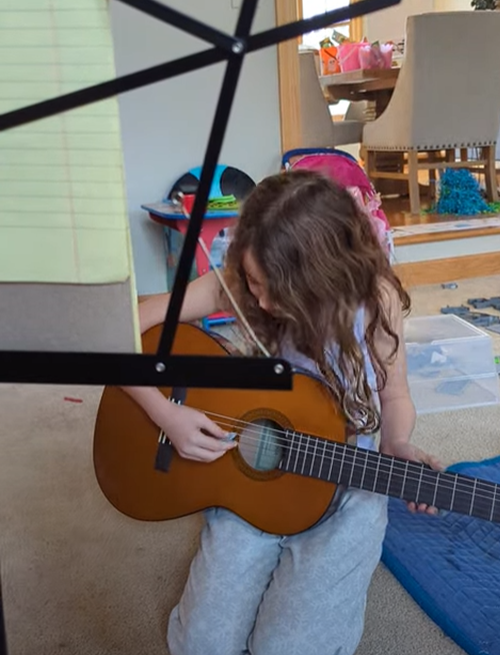
My daughter is a creative, curious, wonderful kid. And something she’s recently gotten excited about is music. We have a musical household. We love to listen to all kinds of different genres and artists. Piano lessons, the annoying drum set, all of it. And Taylor Swift inspired her to try to pick up a guitar and become a #songwriter. The guitar isn’t going great, she’s got a lot on her plate. But the songs, and specifically the lyrical piece, was a thing she got really inspired to try. So she started writing. A lot.
They were pretty good for a 10 year old. Honestly, they’re probably better than I could do. And it was clearly her voice, her ideas, her point of view. She’d write it down on paper, maybe type it up on her little Chromebook from school, and have her “songbook”. It was really cool. I was really proud of her and most importantly, she was proud of herself. You could see the wheels spinning in her brain. You could see her building that creative muscle and that confidence.
Then she was at school one day, talking to her teacher about the songs she was writing. This teacher is wonderful and kind and caring, and she knew that Emma didn’t really know how to play guitar. She wanted Emma to be able to hear her songs as a more finished product. So she introduced her to an app called Suno where you can upload your lyrics, pick a genre, pick a voice, and it will take your lyrics and build you a fully baked, professional-sounding song. A song you can download and send to friends or listen to over and over again.
It’s an amazing example of the technology that’s available right now. It was thoughtful and creative for her teacher to give her a tool that could help her see what her songwriting could become. And if I didn’t pay attention, I would have encouraged her to keep using it. But here’s the thing. There’s a second way to use that app. A seemingly innocent mode. It’s the one that will let you enter a prompt and it will write the lyrics for you.
Like all AI, you can be as specific or as general as you choose to be. I could tell Claude to write me a 15-page paper on the fall of the Roman Empire through the lens of a historical economist focused on how policy choices impacted inter-regional trade. Or I could just say, “hey, write me a paper about the fall of the Roman Empire”. Those would be two drastically different papers. They’d both be quality essays. If I didn’t care about the perspective, it would probably get a decent grade. But one would be far away from what I actually needed, and one would clearly be inferior to the other.
So with this app, my daughter had the option to say: “write me a song about love in the style of Taylor Swift. Then write me a song about annoying parents in the style of Charli XCX” Etcetera, etcetera. You get the idea. And don’t get me wrong, those would have been good songs. She probably would have detailed prompts and creative ideas. But she wouldn’t have done the hard thing of actually crafting the story and the lyrics. So it would have been a moment where this creative 10 year old unknowingly chose to outsource her thinking.
That’s the danger. For one, she’s too young to realize what she’s doing. And two, she would have probably gotten a lot of praise for the quality of the songs. Her mom and dad would have smiled and listened and danced. We would have told her she was talented. And that would reinforce that it was not only ok, but probably better, to have AI do the hard part for her. Over time, she’d never get the chance to build that creative muscle. How to build a story and create something from her heard and mind. She wouldn’t get the chance to be frustrated and have to revise, adjust, experiment, and improve. She’d just crank out bops that were cute and interesting and cliched. She wouldn’t have anything that was hers.
It’s not just about the song writing. The odds are she isn’t the next Taylor Swift (DO NOT TELL HER I SAID THAT). But she’s building her voice, her creativity, and her critical thinking skills. And those will be so important to her future. It will make her irreplaceable.
So now we have a rule in our house. You can use the app. But you can never have it write your lyrics.
The difference is it forces her to bring her ideas and perspective to the table. She is the one telling the story, and figuring out each piece of it. She can polish the song in the app. She can have it do the drum beats. She can even say, hey, I’m having trouble with this section, any advice or ideas? That’s fine. But the instinct and impulse to just quickly outsource the thinking, because the end product will look good enough, is a really dangerous game.
So back to the concept of critical thinking as a muscle. Because that’s what I’m already seeing start to fall outside of my house, and even with me.
The thing about muscles is that if you don’t use them, they atrophy. But it’s not always obvious, and it won’t always make a difference…until it’s too late.
I was teaching a high school entrepreneurial class about practical AI, lecturing about the importance of protecting their critical thinking abilities. I was trying to figure a good analogy, so I asked the class, by show of hands, how many of them were athletes? A good portion of the class raised their hands.
I said: if you stopped lifting weights for a week, or you stopped practicing your sport for a week, would you notice?
They instantly said yes. A week off from lifting and it’s harder to get up the same reps at the same weight. They know what that feels like. They know the value of continuing to train, because if you don’t, it starts to go.
That’s not the dangerous part. The bigger problem is that while they know they’re off a little bit, no one else will really notice after a week. You still look the same. You’re not going to lose that much muscle mass in seven days. You’ll be a little off, a little slower, a little weaker. But you’ll look the same. Two weeks, three weeks, a month, a year, visually people may not notice nearly as quickly as you do. But then when it’s time for the game or the race, and you’ve slacked on keeping those muscles ready, you’ll fail. You’ll get beat. And it wasn’t because of a single day or one decision. It was because you started to take it easy. And you eventually paid the price.
That’s how I feel about the brain. That’s how I feel about creativity and critical thinking.
It is very easy to say, write me a paper about the Roman Empire. It is harder to think through: here are the exact things I need, here’s the length, here’s the purpose, here’s the outcome I’m after. Here’s what great looks like to me. That’s harder work for your brain. More reps, more weight. But if you keep outsourcing your thinking, if you keep hitting the easy button because the output looks good enough (to you or someone else), that’s the athlete who’s been skipping the gym and saying, well, I still look like a football player. You’ll look the same for a while. But you’re going to be a little slower. A little weaker. Not what you’re capable of being.
These tools are everywhere and there are not a lot of frameworks around how to use them. So here’s mine, for now: do the hard work. Write the lyrics. Think through the paper. Use AI to polish, to produce, to get unstuck, to go further. But don’t let it do the reps for you.
P.S. Emma’s still writing her own songs. They’re still really good.
